
Director's Statement
Jem Cohen on the making of "Benjamin Smoke":
I met Benjamin in 1989 when I was in Athens, Georgia, doing some film work for the band, R.E.M. I saw posters for an Atlanta group called the Opal Foxx Quartet that was coming to town, and a number of people, including R.E.M.'s singer, Michael Stipe, told me that this was a show I must not miss. I recall being surprised that so many of the rock and roll people I knew were interested in classical music, or was it jazz? It turned out to be neither, and they were no quartet. We went to a tiny venue called the Downstairs, and in came a band that seemed bigger than the audience, playing such things as violin, cello, organ, electric guitars, and in the case of the 300 pound "redneck poet" Deacon Lunchbox, a cap pistol, used for percussion. The band was led by Benjamin, in the guise of "Miss Opal Foxx," a scrawny little powerhouse in a sun dress, carrying a battered purse and belting out an amazing set of songs: ballads of Southern wear and tear, punk rock rave-ups, strange blues, and everything in between. I remember a catchy song called "Frail Body" whose chorus was:
Gotta get it up, gotta get it up and show you I'm a man . . . Gotta get it up on the outside, cuz the inside's caving in.
As Benjamin put it: "For a faggot, do I have a rockin' band or what?"
Some time later, Stipe brought the band into a studio to produce their demo tape, and I hung around and got to know Benjamin. Super 8 film from that period would end up in the documentary ten years later.
After a series of tragic deaths of some of the musicians in Opal Foxx, the band Smoke was born, and I began the collaboration with Pete Sillen, who had made a short about another underground musician from Georgia, Vic Chesnutt. We wanted to see how the new band would function, but mostly, we wanted to document Benjamin. He was a natural and increasingly rare kind of storyteller, a bit of a deep South, dirt-poor Oscar Wilde. Time with him was always fascinating. Still, we didn1t know that we were "making a documentary." We just wanted to capture something that we knew was remarkable. And even before we knew that Benjamin was sick, we knew that it might not last.
There never was a producer or crew or any trained assistants. We shot on 16mm film, often using spare "short ends" of film that were left over from other jobs, and when that wasn¹t available we added some video and Super 8 film. We recorded sound on a DAT walkman, or just on audio cassettes, and when we had no sound equipment or spare hands, we shot silent.
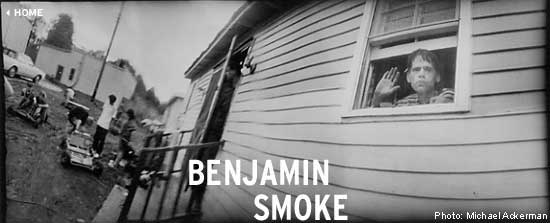
Benjamin lived in an extraordinary neighborhood called Cabbagetown. Shooting there was never easy, and not just because it wasn't a safe place. From the minute we stepped out of the car, there was too much to capture, too much slipping away, too much out of control. Benjamin was happy to have us come, but he might disappear for days on end, and sometimes he was in bad shape. Still, once he knew that we weren't going to judge him, he was always open, and was never troubled by the camera. When we asked to shoot some old pictures from his life, Benjamin went to an old filing cabinet and searched for a while, finally coming up with what looked like a brick.
It turned out to be a solid block of photographs that had been damaged by water and stuck together in one piece, seemingly ruined. We felt terrible, but Benjamin was unfazed and began to peel them apart, fascinated by the psychedelic patterns caused by the destroyed emulsion. We used what we could salvage in the film, and it ended up making perfect sense that way. In fact, that is how much of the project was built, using fragments, odds and ends, making do with what we had.
The fact that Patti Smith ended up in the film was also a matter of chance and echoed circumstance. She was probably Benjamin s greatest influence; she was the magnet that drew him to New York for a short time in the late 1970's where he got work sweeping up in CBGB's, the infamous punk club. He met her briefly, but returned to Georgia, to life as a speed-freak, drag-queen, and musician, never much known outside of the Atlanta underground. None of us could have guessed that she would one day see his band, even in their last days, and that this would lead to an inspiration in her own work that we would document in the film - a sad, beautiful, perfect circle.
BENJAMIN SMOKE was never intended to be a traditional documentary. It is a portrait of a musician, a music film, but one that avoids the promotional cliches employed in today's superstar obsessed climate. He was a genuine underground figure, an outsider whose difficult life was channeled and transformed by the music that he made, and whose music transformed others. It is a film about the struggle with AIDS and the effects of addiction, but it is also something of a comedy. It depicts a neighborhood in transition, reflecting the colliding forces that are creating America's "New South." Perhaps most surprising to us, the filmmakers, is its broader function as a narrative reflection on art and chance. BENJAMIN SMOKE is the story of a boy growing up in the rural South who sensed his own difference, a "queerness" that isn't just about gender. It tells how he heard the call of distant heroes whose championing of renegade paths gave him a direction to follow, and how his own journey then came to affect some of these once-distant heroes.
-- Jem Cohen, February 2000

| C-HUNDRED
FILM CORP AND COWBOY BOOKING INTERNATIONAL PRESENT A CO-PRODUCTION OF GRAVITY HILL FILMS AND PUMPERNICKEL BENJAMIN SMOKE A FILM BY JEM COHEN AND PETER SILLEN |
|
| EDITED BY | NANCY ROACH |
| ADDITIONAL EDITING BY | COHEN / SILLEN |
| PHOTOGRAPHED BY | COHEN / SILLEN |
| EXECUTIVE PRODUCER | NOAH COWAN |
| LOCATION SOUND | COHEN / SILLEN |
| ON-LINE FACILITY /POST-PRODUCTION ASSISTANCE | POST 391 |
| POST-PRODUCTION CONSULTANT | BRIAN A. KATES |
| POST-PRODUCTION SOUND | ANDY
KRIS MARY ELLEN PORTO akme sound |
| ADDITIONAL POST PRODUCTION SOUND | Mercer Street Sound |
| ADDITIONAL SOUND RECORDING | Lance
Weiler David Leitner Adam Cohen |
| LIVE STUDIO RECORDING | Brett
Neal (Rob Mallard Studio) |
| ADDITIONAL CAMERA | Sarah Cawley |
| PRODUCTION ASSISTANTS | Lance
Bangs Charles Greenleaf Joshua McKay Michael Ackerman |
| LAB | DuArt Film and Video |
| NEGATIVE MATCHING | NoÎlle Penraat Inc. |
| TAPE TO FILM TRANSFER | FilmTeam |
| SPECIAL THANKS | Michael
Stipe Jim McKay Patti Smith Post 391 Jeff Levy Hinte Jennifer Ruff Dave Smith Miriam Cohen Jill Kalish and Steve Pilon (Long Play Records) Susan H. Bodine Andrea F. Cannistraci Jimmy Crook |
| MUSIC BY | Smoke |
| ALBUM CUTS COURTESY OF | Long Play Records |
| ADDITIONAL WRITERS / CO-WRITERS | |
| "Hank Aaron" | Lyrics
by Dana Kletter (adapted from "Hope" by Dana Kletter/the blackgirls) |
| "Hot Pearl Buttons" | Lyrics by Tracy Snow |
| "Thief" | Debbey Richardson, Tracy Snow, Benjamin |
| ADDITIONAL MUSICIANS/PRODUCERS | Easturn
Stars Jo Jamison Neil Fried |
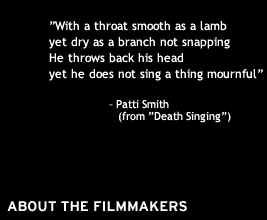
"Death Singing" (c) Patti Smith/Druse Music, Inc. |
|
| SMOKE | |
| BENJAMIN | Lead vocalist/ Writer |
| TIM CAMPION | Percussion |
| BRIAN HALLORAN | Cello |
| COLEMAN LEWIS | Guitar |
| BILL TAFT | Trumpet/ Banjo |
Jem
Cohen
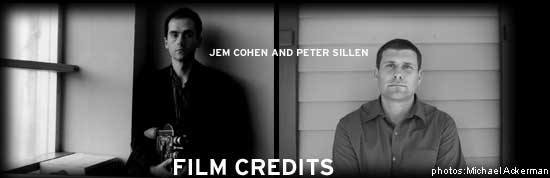
Jem Cohen is a New York-based director and cameraman. His work over the
past 15 years has been built from his own ongoing archive of street footage,
portraits, and sound. He mixes documentary, narrative, and experimental
genres, as well as film and video. Cohen's LOST BOOK FOUND won 1st prizes
at Locarno, the Bonn Videonale, Film + Arc (Graz, Austria), and the Festival
Dei Popoli (Florence). Earlier works include THIS IS A HISTORY OF NEW YORK,
JUST HOLD STILL, and BURIED IN LIGHT, originally commissioned by the High
Museum in Atlanta as a 3-channel video installation. INSTRUMENT, the feature-length
documentary on the band, Fugazi was chosen for the 2000 Whitney Biennial.
AMBER CITY, an Italian city portrait, won 1st prize in the Video Competition
at Locarno '99. Recent releases include BLOOD ORANGE SKY, a commissioned
portrait of a city in Sicily, and the short, LITTLE FLAGS. Cohen has worked
extensively with musicians including R.E.M., Elliott Smith, Jonathan Richman,
Miracle Legion, Vic Chesnutt, and the Orpheus Orchestra with Gil Shaham.
The last of Cohen's five R.E.M.videos, "E-bow" won the best Music Video
award at the San Franciso Intl. Film Fest, and his earlier longform video,
"Nightswimming" premiered at the Telluride Film Festival. Cohen's works
have been broadcast by the BBC, PBS, Planete, and TVE (Spain). He is a Rockefeller
Fellow, and has received grants from the Creative Capital Foundation, the
Jerome Foundation, New York State Council on the Arts, New York Foundation
for the Arts, and residencies at Yaddo and the MacDowell Colony. As a cameraman,
Cohen received an Emmy award in 1999 for work on the PBS' "City Life" program.
At a time when "independent film" has been largely subsumed by the Hollywood
model, Cohen's work is a reminder of the term's original meaning and potential.
Peter Sillen
Peter Sillen is a New York-based documentary filmmaker. Working in 16mm
film, Sillen portraits an array of individuals who live and work outside
the stereotypical 9 to 5 environment. With a low-tech approach to documentary
film and sensitivity to his subjects and their environment Sillen's work
gives an unobstructed view into the lives of a number of uniquely talented
artists and tradeworkers. Current projects include FREE AND ACCEPTED, a
feature length documentary work-in-progress exploring the tradition, rituals
and membership of the Masonic Order in America, and GRAND LUNCH is a 5 minute
work-in-progress documenting the final days of the Grand Luncheonette, one
of 42nd Street's unforgettable hotdog/lunch counters. His documentary Speed
Racer:Welcome to the World OF Vic Chesnutt premiered at the Sundance Film
Festival in 1994 and was nominated for the International Documentary Association
Distinguished Achievement Award shorts category. Peter has received grants
from the Jerome Foundation and the NY State Council of the Arts. His work
has been broadcast on PBS, as well as seen at numerous film festivals around
the world.
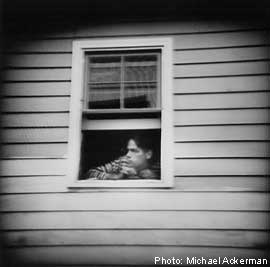
Michael Ackerman (Cabbagetown still photography)
Michael Ackerman's haunting photographs have earned him the title of one
of the most promising talents of his generation. Named Young Photographer
of the year in 1997 by the International Center of Photography, Michael
Ackerman's work has shown to great acclaim at the Zentrum Fur Fotographie
(Berlin), the Grazia Neri Gallery (Milan), the Margaret Bodell Gallery,
Ltd. (New York City), and the Agence Vu Gallery (Paris), amongst other places.
His work has appeared in 'The New Yorker,' 'Granta,' The New York Times
Sunday Magazine,' 'Aperture,' and 'Ray Gun." Michael Ackerman is represented
by the Margaret Bodell Gallery.
[Note: You may not wish to read the following if you have not seen the film.]
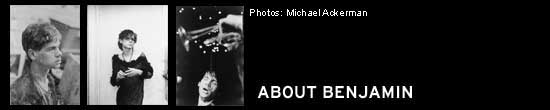
Born in Atlanta in 1960, Benjamin felt "queer" from a very early age and by
the time he was nine he was spontaneously experimenting with drag ‚ "roller-skating
in the basement in (his) mother's clothes." He left home around the age
of 17 and eventually dropped all last names, taking on the permanent alias,
"Benjamin."
He moved to rural Georgia, living with an older boyfriend in a small house
without heat or hot water. (When asked what he did during that time, his
answer was "not a lot.") Although he didn't listen to music much, he managed
to hear Patti Smith's "Horses" album. Deeply affected, he moved briefly
to New York in 1978 and worked as a bar-boy at the punk club, CBGB's.
He got to know Richard Sohl, the keyboard player in the Patti Smith Group,
and met her briefly, but subsequently moved back to rural Georgia and
then again to Atlanta. After working as a graveyard-shift waiter at the
International House of Pancakes and at other local restaurants, Benjamin
eventually gave up on "straight" jobs altogether and settled in to life
as a musician, speed freak, and drag-queen. In the mid-eighties, he did
make return visits to New York City with RuPaul, Lady Bunny, and other
members of Atlanta's burgeoning drag underground who were hired to appear
at clubs like the Pyramid Lounge. Unlike some of these soon-to-be famous
contemporaries, whose fortunes were to be made in lip-synching, Benjamin
remained in Georgia and dedicated himself to performing in a series of
marginal bands. He became a fixture in the local underground scene, which
encompassed punk and new wave music, the drag-queen community, and the
more radical noise-band and performance art fringes that found their moment
in events like the "Destroy All Music" festival. His early bands included
Medicine Suite and Easturn Stars, the latter consisting of Benjamin and
"four angry young dykes" performing on homemade and toy instruments. Later
incarnations included the somewhat more straight-ahead but equally aggressive
punk band, Freedom Puff, which got itself banned from a number of local
venues. Aside from Patti Smith, Benjamin's musical heroes included Nina
Simone, the Georgia singer-songwriter Vic Chesnutt, and a number of less
known Southern musicians whom he often collaborated with, and whose songs
he covered or made his own.
Often itinerant, occasionally homeless, Benjamin moved all over Atlanta,
eventually ending up ensconced in the isolated neighborhood called "Cabbagetown."
The backdrop for much of the film, Cabbagetown was originally a mill-village
or company town built around a textile factory. It was populated by immigrant
Appalachians who had a self-sufficient if dirt-poor community. When the
mill closed in the 1970's, the community was left behind and in the lurch,
experiencing severe problems with unemployment, drugs, and prostitution.
Eventually, artists, musicians, and members of the gay community looking
for cheap housing began to move in to its "quaint" clapboard houses, unwittingly
serving as the first wave in the gentrification to come.
In the late eighties, offered a series of brunch gigs at a local bar/coffee-shop,
Benjamin took on the drag persona of Miss Opal Foxx and led the infamous
Opal Foxx Quartet. This band consisted of up to twelve members playing
instruments including violin, keyboards, and electric guitars. It also
contained the 300 pound "redneck poet" Deacon Lunchbox, who recited
poems and sometimes used a cap-gun for percussion. Atlanta favorites,
their demo was produced by Michael Stipe of R.E.M. (from nearby Athens)
who had known of Benjamin since his early days in the local Georgia underground.
Despite Stipe's efforts to introduce the band to the music industry, they
were never signed. Deacon was eventually killed in a car accident, and
the drummer overdosed on heroin. Eventually, a CD release, "The Love that
Won't Shut Up" collected the Stipe demo sessions and other recordings.
Smoke was born out of the remnants of the Oppal Foxx Quartet, and managed
to become both locally popular and nationally recommended, at least by
a few critics. The local alternative press weekly, Creative Loafing, chose
them as 1995's "Best Alternative Band," and the LA Weekly claimed of "Heaven
On a Popsicle Stick": "It's not often that you stumble onto a record with
as rare and fragile a sense of majesty as this debut." Even Billboard
Magazine praised their "uncannily original, oft-disquieting folk noir
sound," but also called them "maddeningly hard to describe." Smoke released
two CD's on LongPlay, an independent Atlanta label. The occasional rave
reviews were not accompanied by a major label signing, or high record
sales. Although the band had brief touring engagements, including opening
gigs for the Mekons and a short cross-country tour with Cat Power, their
experience outside of the South was limited. They did manage to play a
number of times in New York, and it was on one such trip that Patti Smith
came to see the band, which led to the remarkable results which unfold
in the film.
Contrary to popular belief, Benjamin was not a Heroin addict or alcoholic;
his drugs of choice were Speed, barbituates, and pot. (And cigarettes
- an extreme chainsmoker, he was particularly fond of the expression "Better
to smoke here than in the hereafter"). After years of shaky health, compounded
by the effects of an early liver problem, Benjamin's condition declined.
He tested positive for AIDS in the mid 1990's. Changes in his lifestyle
and medical advances such as the newer AIDS "cocktails," (as well as devoted
care by his mother) led to massive improvement, but the years of hard
living had taken their toll.
Weeks before his death, Benjamin played a final show at the Clermont Lounge,
the low-end Atlanta strip bar where his bands had found a second home.
He performed in drag, stunning an audience that could hardly believe he
would make it onto the stage. By morning he had also made it in, and back
out, of the local emergency room. The direct cause of Benjamin's death
in 1999 was Hepatitis C and liver failure, although both conditions were
entwined with his drug use and struggle with AIDS. He died at home in
his sleep, immediately after his 39th birthday, in the company of his
mother.
For more information about Benjamin please visit Brian Halloran's website:
www.benjaminremembered.com
